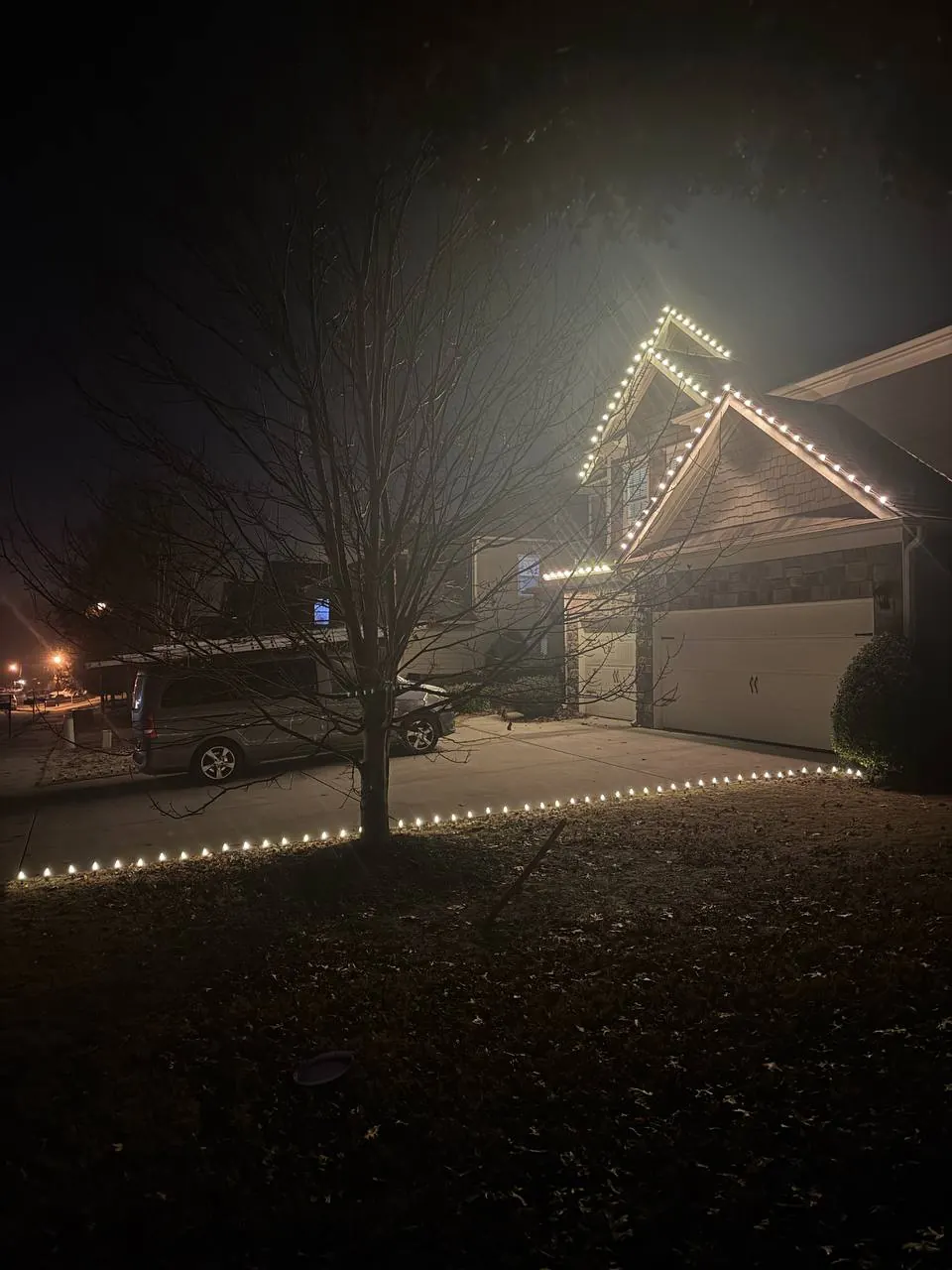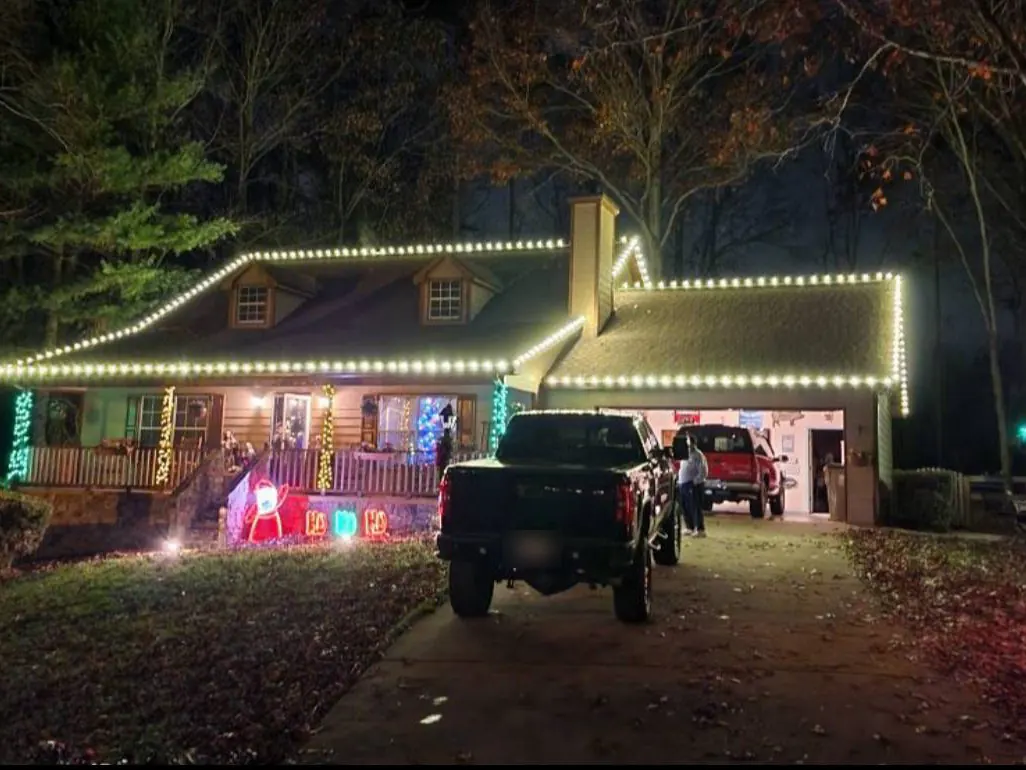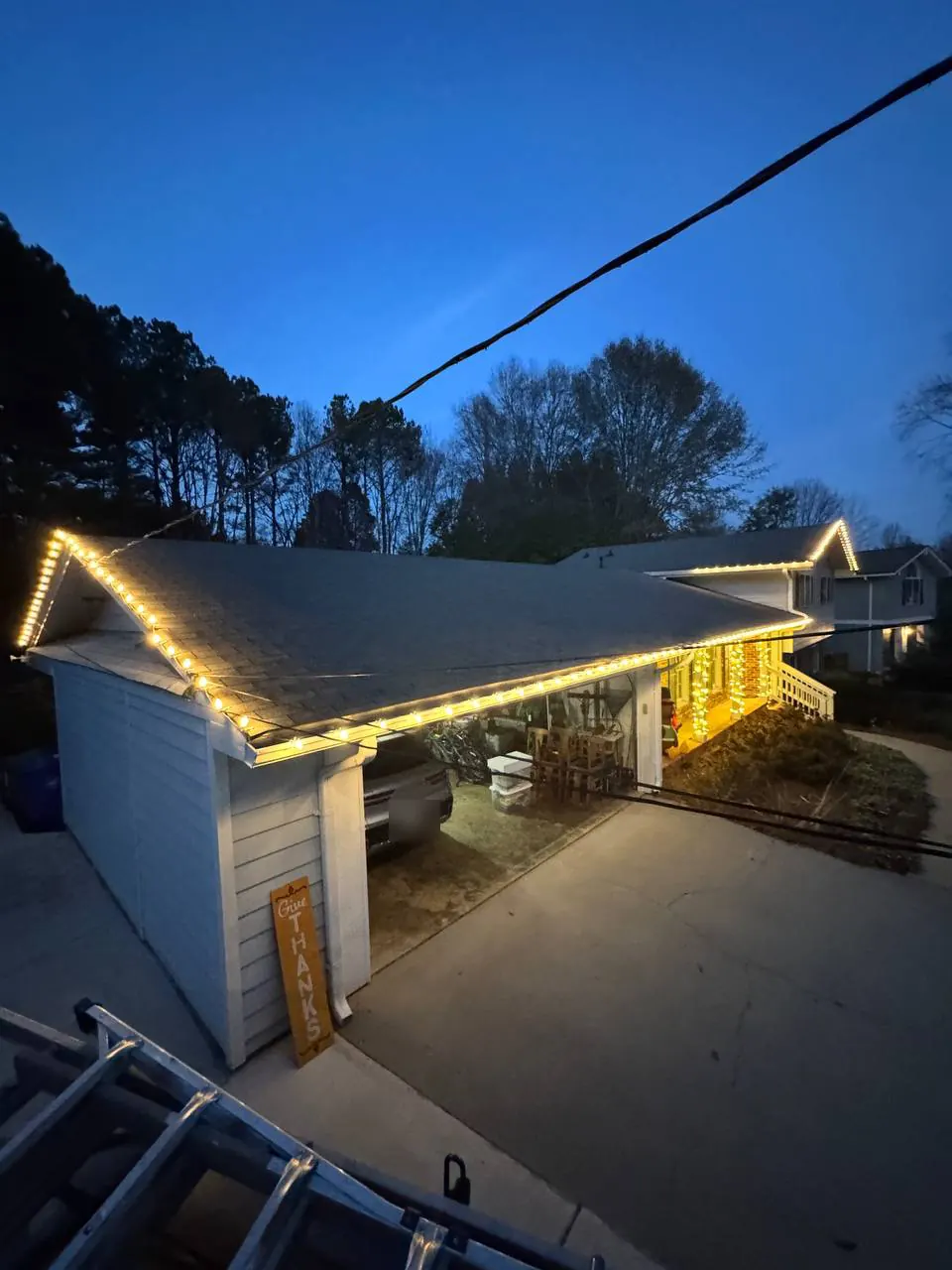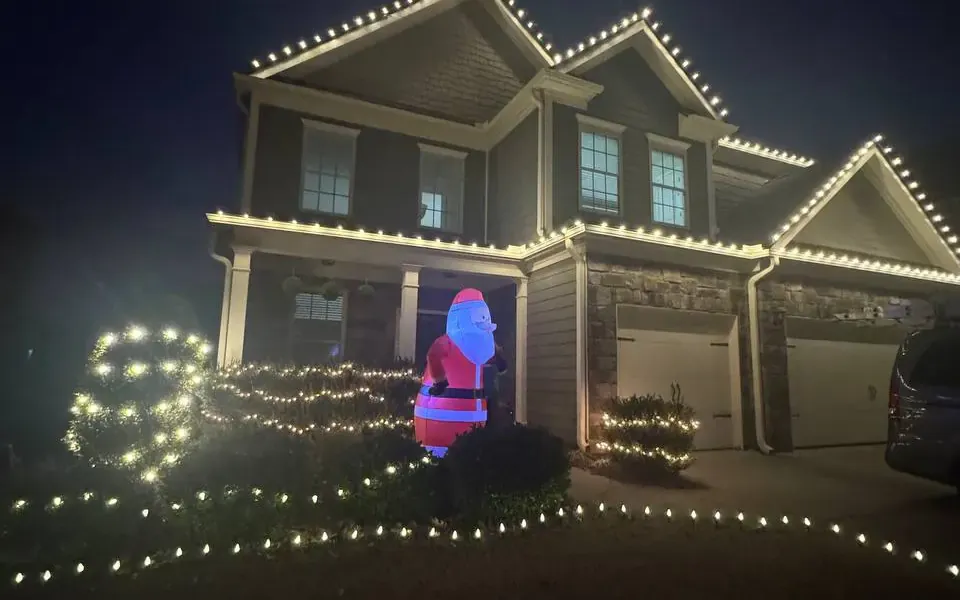
Most LED Christmas light displays add very little to a power bill. An LED C9 bulb draws under one watt, so a 100-foot roofline with about 100 bulbs uses roughly 100 watts or less while it’s on. Run that on a timer for six hours a night through a holiday season and you’re looking at a couple dozen kilowatt-hours, which at a hypothetical 15 cents per kWh works out to a few dollars for the whole season. Old incandescent bulbs are a different story, and the math below shows why.
You don’t need to trust our round numbers. Here’s how to work it out for your own house in about two minutes.
The formula
There are four numbers you need:
- Total watts of everything on the display
- Hours per night the lights are on
- Nights in your season
- Your rate in cents per kilowatt-hour (kWh), from your power bill
Then:
watts × hours × nights ÷ 1,000 = kWh
kWh × your rate = cost for the season
That’s it. The rest of this post is just filling in the numbers.
Step 1: how many watts?
Wattage depends on the bulb type, and this is where LED and incandescent split apart. These are general, commonly published figures for each bulb type. The exact number for any given product is printed on the box or the tag near the plug.
| Bulb type | Incandescent (approx.) | LED (approx.) |
|---|---|---|
| C9 bulb (large roofline bulb) | about 7 watts each | under 1 watt each |
| 100-count mini light string | about 40 watts | about 5 watts |
To get your total, count bulbs. Roofline C9s and C7s are usually spaced 12 inches apart, so one bulb per foot is a fair estimate. A 100-foot roofline is about 100 bulbs. If you don’t know your footage yet, our roofline measuring guide walks through it with a tape measure and a satellite view.
Then add the shrubs and trees. Count the mini light strings (or estimate them) and multiply by the per-string figure.
Step 2: hours and nights
We set a timer at install, so this part is predictable. A common setup is dusk to about 11 p.m., which in late November and December in Atlanta is roughly six hours. For the season, count the nights from the date the lights go on to the date you want them off. Lights installed in mid-November and running through early January can easily be on for 40 to 50 nights.
For the examples below we’ll use 6 hours a night and 40 nights, which comes to 240 hours.
Step 3: your rate (read your own bill)
Your per-kWh rate is on your monthly bill. It moves with the season, your rate plan, and any fees or riders your utility adds, and published “average” figures from third-party sites don’t always agree with each other. So for these examples we’ll use a hypothetical rate of 15 cents per kWh, just to keep the math easy. Swap in the number from your own bill for a real answer.
Worked example: a 100-foot roofline
LED C9s
- 100 bulbs × 1 watt (rounding up to be safe) = 100 watts
- 100 watts × 240 hours ÷ 1,000 = 24 kWh
- 24 kWh × 15 cents = 360 cents, or about three and a half dollars for the season
Incandescent C9s
- 100 bulbs × 7 watts = 700 watts
- 700 watts × 240 hours ÷ 1,000 = 168 kWh
- 168 kWh × 15 cents = 2,520 cents, or about twenty-five dollars for the season
Same roofline, same hours, roughly seven times the power.
Worked example: roofline plus shrubs and a tree
Say you add 10 strings of LED mini lights for the front shrubs and one wrapped trunk.
- 10 strings × 5 watts = 50 watts
- Roofline LEDs = 100 watts
- Total = 150 watts
- 150 × 240 ÷ 1,000 = 36 kWh
- 36 kWh × 15 cents = 540 cents, a little over five dollars
With incandescent minis (10 × 40 = 400 watts) plus incandescent C9s (700 watts), the same display pulls 1,100 watts. Over 240 hours that’s 264 kWh, or about forty dollars at the same hypothetical rate. That’s a real line on a December bill.
Quick checklist: estimate your own display
- Measure or estimate your roofline in feet (one C9 per foot)
- Count shrub and tree strings
- Look up the watts on the box or tag (or use the table above)
- Decide your timer hours
- Count the nights from light-up to takedown
- Find the per-kWh rate on your own power bill
- Multiply it out
Will the lights overload my outlet?
With LEDs, almost never. A standard household circuit is 15 amps at 120 volts, or 1,800 watts, and the usual rule is to keep a continuous load at no more than 80 percent of that, which is 1,440 watts. The incandescent example above (1,100 watts) is getting close, and bigger incandescent displays used to trip breakers every year. The LED version (150 watts) barely registers.
Outdoor outlets are almost always on a GFCI, which trips when it senses a leak to ground, usually water in a connection. That’s a safety feature, not a sign the display is too big. If you want to check your outlets before install day, our install day checklist covers the reset steps.
What we hang, and why it matters for your bill
Every seasonal install we do uses commercial-grade LED strands, cut to the measured length of your roofline. That shows up in three places:
- Low power draw. The numbers above.
- Timer control. We set the timer at install, so the lights aren’t burning at 3 a.m. because someone forgot to unplug them.
- Fewer cords. Low-wattage LED runs can share outlets that an incandescent display would overload.
You can see the options on the roofline lights and trees and shrubs pages, or the whole-house package if you want everything at once. For lights that stay up all year and switch colors by holiday, look at permanent lights. Shops thinking about evening hours can find notes on the small business page.
We hang lights across Cobb County, Gwinnett County, North Fulton, and the rest of the metro. To see what your house would need, text a photo to (470) 470-4485 or use the contact form. Your quote covers the lights and the work. The power bill stays small.
Common questions
How much electricity do LED Christmas lights use?
Very little. A typical LED C9 bulb draws under one watt, and a 100-count string of LED mini lights draws roughly 5 watts. A 100-foot roofline of LED C9s at 12-inch spacing is about 100 bulbs, so figure around 100 watts or less while it is on.
How do I calculate what my Christmas lights cost to run?
Multiply total watts by hours per night and nights in the season, divide by 1,000 to get kilowatt-hours, then multiply by the per-kWh rate on your power bill. Use the all-in rate from your own bill, since fees and riders change the real number.
Are LED Christmas lights really cheaper to run than incandescent?
Yes, by a wide margin. An incandescent C9 bulb is typically about 7 watts, while an LED C9 is under 1 watt. The same roofline outlined in old-style C9s can use around seven times the power of LEDs.
Can Christmas lights overload a circuit?
Incandescent displays could. A standard 15-amp household circuit should stay under about 1,440 watts of continuous load, and a big incandescent display can get there. An LED display for a typical house uses a small fraction of that.